
UNLOCK INSTANT CASH FLOW FOR YOUR SME
Tired of waiting 30, 60, or even 90 days for customers to pay their invoices?
Frustrated by the amount of time and energy you spend chasing customer payments?
Late payments can strangle your cash flow, hobble your business growth AND force you to spend valuable time chasing clients for money.
Receivables Management Finance is a game-changing business financing tool that:
- Turns your unpaid invoices into immediate cash AND
- Frees you from debt collection tasks – for good!
For many small small businesses, “collections” is a daily load of stress and frustration. It can also be a constant distraction from core business operations.
Receivables Management Finance is a practical, efficient, solution-driven approach to cash flow management that lets you focus on building your business, instead of chasing payments.

KEY FEATURES AND BENEFITS OF RECEIVABLES MANAGEMENT FINANCE FOR SMES
WHAT DOES RECEIVABLES MANAGEMENT FINANCE ACTUALLY DO?
There are two key things that Receivables Management Finance does:
- Delivers Instant Cash Flow: Say goodbye to cash flow shortages.
Receivables Management Finances uses the best of today’s practical, integrated financing tools to convert your outstanding invoices into immediate working capital. Instead of waiting months to get paid, you receive cash within days – so you can cover expenses, pay staff, and seize growth opportunities without delay. - Freedom From Chasing Invoice Payments: Say goodbye to acting as a debt collector.
With Receivables Management Finance, your financing partner takes over the task of following up with your customers. You are free from the burdens and costs of chasing invoices, and can focus on building quality customer relationships.
WHAT DOES THIS MEAN FOR YOUR BUSINESS?
The BENEFITS of these two core functions of Receivables Management Finance are what grows businesses and their impact. The results that these two deliverables offer your business include:
By leveraging these benefits, you can maintain a healthy cash position and avoid the recurring cash flow crunches that holds so many businesses back.
RECEIVABLES MANAGEMENT FINANCE – THE KEY TO FINANCIAL PEACE OF MIND FOR YOUR BUSINESS
It bridges the gap between billing and payment, so your business keeps moving forward.
Imagine having the confidence to take on a big new order because you know you can unlock the cash tied up in your receivables immediately.
Are you ready to stop worrying about cash flow and start focusing on growth?
TALK TO A WORKING
CAPITAL STRATEGIST

WHAT IS RECEIVABLES MANAGEMENT FINANCE?
Receivables Management Finance is a powerful business financing tool that combines expert customer management services with today’s leading Invoice Financing tools. The result is a seamless, trouble free and affordable Accounts Receivable solution that enables Australian SMEs grow, through:
- Super-professional Receivables Management Services delivered by expert business finance communicators; PLUS
- Carefully selected Cash Flow Finance tools that advance up to 80% of the invoices you bill within 24 hours.
Additionally, Receivables Finance Management offers you the option to protect your Cash Flow from unexpected customer failures with Debtor Insurance at affordable wholesale rates.
WHAT DOES RECEIVABLES MANAGEMENT FINANCE DELIVER?
WHAT DOES RECEIVABLES MANAGEMENT FINANCE COST?
Receivables Management Finance is a business finance product. Like any business finance product – from a credit card to an unsecured overdraft – it comes with fees and risk-based interest charges.
What’s different about Receivables Management Finance is that the risk assessed is primarily the ability of your customers to pay agreed invoices (not your projected business performance).
Receivables Management Finance is customised to your business needs, so the exact costs will vary. However they are competitive with other finance products, and come with the added benefit of no more chasing payments.
Here is an example of how the product works.
A RECEIVABLES MANAGEMENT FINANCE EXAMPLE
Let’s say that you’re using Receivables Management Finance to access cash now on 30 day or 60 day customer invoice payments.
Let’s also suppose that you’re paying an interest rate of 12% per year plus a fee of 1 to 2% for each invoice “mini-loan”. So if your customer’s invoice is on 30 day terms and they pay promptly, then your costs are 1 to 2% in fees and 1% in interest (2 to 3% overall).
On an invoice of $10,000, that’s $100 in fees and $100 in interest.
The financing tool is integrated with your online accounting tool (for example, Xero or QuickBooks) – so there’s no extra manual paperwork or approval process.
That $200 in fees and interest will put $8,000 in your bank account today – which you can use today to buy stock in bulk or upgrade a computer. (When your customer pays, the $200 cost is taken out of the $2,000 balance and the remaining $1,800 goes into your bank account.)
(Plus you have zero in-house costs for the work of following up any late customer payments.)
Whether that’s “expensive” depends on the return you get on what you do with the funds that Receivables Finance Management liberates.
NO AMOUNT OF “BETTER CASH MANAGEMENT” CAN FIX YOUR INDUSTRY’S STRUCTURAL CASH GAP
All the administrative discipline in the world can’t change the impact of “baked-in” credit terms with long payment periods.
Long credit terms will still have you waiting weeks – and even months – for a big customer to pay a big invoice. During that time, payroll still has to be made, the ATO wants their due, and your suppliers have to be paid to buy materials for your next job.
Even good businesses that show excellent profits at the end of the financial year can operate in and environment of recurrent, stressful, productivity-killing periods of cash flow drought.
HOW CAN YOU RECOGNISE THE CASH TRAP?
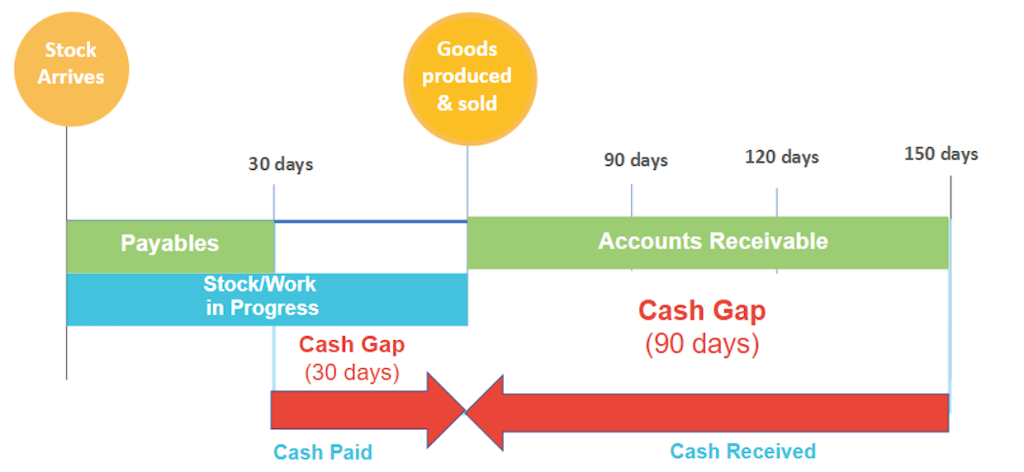
THE COSTS OF THE CASH TRAP ARE HEAVY AND CUMULATIVE
If you don’t have sufficient working capital in your business, then you can end up:
With Receivables Management Finance maximising the flow of funds into your business, you can…
Is Your Business Stuck in a Cash Trap?
Talk to Martin about how you can get back in the drivers seat
ISN’T RECEIVABLES MANAGEMENT FINANCE JUST INVOICE FACTORING?
Long-time finance people have asked me this question a lot – because the product looks similar to an older finance product. My answer is both “Yes – sort of…” AND “No – not really“…
Both a Bell telephone and a smartphone are called “phones” and both make phone calls – but that doesn’t mean they do the same thing the same way.
YES – THE KEY MODEL AND UNDERLYING PRINCIPLES ARE SIMILAR
YES – you do essentially “sell” your uncollected invoices to someone else to collect, hence outsourcing the work of collection and getting paid up to 80% of their value up front.
NO – THE TECHNOLOGY IS 21ST CENTURY SMART
NO – Today’s responsive finance solutions are far smarter and the admin overheads are minimal, thanks to today’s Cloud accounting and a wealth of integrations and information management tools.
NO – IT ISN’T THE “LAST RESORT BEFORE CALLING IN ADMINISTRATORS”
NO – Receivables Management finance is NOT parcelling up a whole lot of doubtful debt from a struggling SME business so that a strong-arm collection agency can try and collect enough cash to keep them afloat.
Receivables Management Finance is a proactive, intentional upgrade to your business’s Working Capital Strategy – an upgrade that reflects the 21st century reality that SMEs cannot function efficiently with the chronic cash flow malnutrition caused by 30/60 day credit terms.
It’s a way to stop treating your Cash Flow scurvy with remedial dentistry and started getting the nutrients you need to keep your business strong.
OUR FULL-SERVICE RECEIVABLES MANAGEMENT FINANCE TOOL IS 21ST CENTURY SMART
You don’t need to do a whole lot of extra administrative work to get your cash flowing with Receivables Management Finance.
You simply invoice your customer in your online accounting system – and RMF puts around 80% of that amount in your bank account the next day.
Our super-professional, experienced collections team then monitor for your invoice payments due and follow up your customers courteously and persistently.
TRADITIONAL BUSINESS FINANCE DOESN’T MEET TODAY’S SME BUSINESS NEEDS
Australia’s big banks have increasingly become building societies – only interested in loans secured by property and other tangible assets. The process of getting a loan is hard work, the approval process takes time, and you end up putting your assets on the line.
The “bank of family and friends” that used to proved substantial unrecognised funds is drying up – badly impacted by today’s increasing cost of living challenges.
RECEIVABLES MANAGEMENT FINANCE IS SUPPLIED BY ENTREPRENEURIAL BUSINESS THINKERS
The same entrepreneurial types who brought us the Internet, eCommerce and Cloud-based accounting tools have ALSO developed a whole range of smarter, SME-friendly finance products.
These products are specifically designed for smaller businesses. They’re smarter, more flexible, more accessible – and overall more responsive to SME business finance needs than traditional finance sources.

Martin Cattach is an expert Working Capital Strategist
Over more than 15 years in the business finance field, Martin has analysed the finances of thousands of businesses.
His decades of experience in the finance industry, Information Technology – AND in small business – uniquely equip him to assist SME businesses to select and implement the best finance solutions for their needs.
Martin will quickly built a Working Capital Cash Flow plan that will take the financial stress out of your business operations and free up the funds you need to grow your business impact.
TALK TO A WORKING
CAPITAL STRATEGIST
WHO SHOULD (AND SHOULDN’T) USE RECEIVABLES MANAGEMENT FINANCE?
RMF works well for those businesses who have a long lead time between purchasing their inputs and getting paid for their work.
It’s useful for industries that are growing including:
- Construction
- Manufacturing
- Transport
- Wholesale
- Fashion
RMF is generally NOT suitable for:
- Sunset industries where growth is trending down
- Short payment cycle industries such as hospitality