WORKING CAPITAL IS THE LIFE BLOOD OF YOUR BUSINESS
The access that your business has to an adequate, timely supply of Working Capital will predict its performance – and whether or not your company can actually grow. It will also predict the level of stress you and your team experience in running your business from week to week.
Without sufficient accessible Working Capital, you business can stagger endlessly from cash flow crisis to crisis. You will constantly struggle to pay your bills while you wait for your customers to pay you what you’ve invoiced.
Working Capital Finance maximises your access to the Working Capital potential within your business, reducing stressful, business-limiting Cash Flow Gaps.
WHAT IS WORKING CAPITAL?
Technically, your working capital is your short term current assets less your short term current liabilities. (Current is anything that will convert to cash within 12 months.)
Your assets usually includes inventory, cash on hand, and money owed to you by customers.
Your liabilities are any short-term debt, money owed to your suppliers, along with any other upcoming expenses.
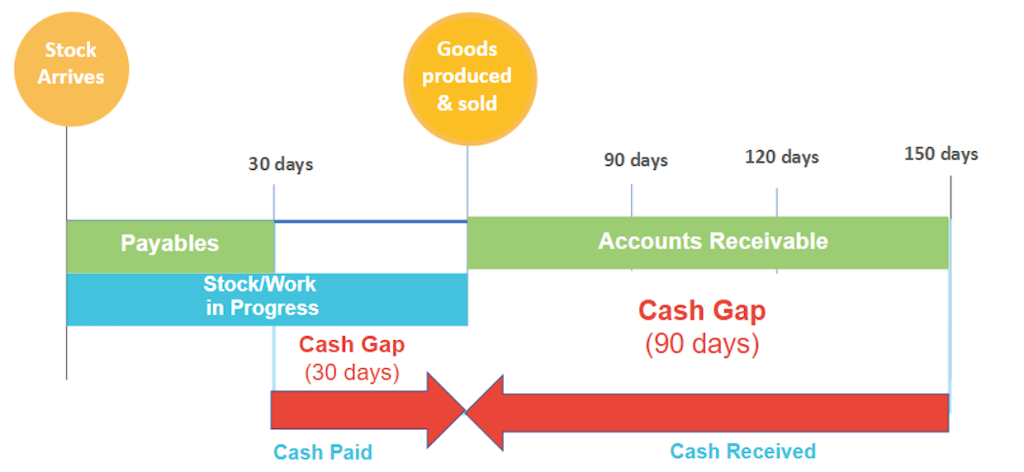
However, in a world of 30/60/90 day credit terms, getting access to the full Working Capital potential of your business is challenging. You end up with a massive, stressful cash gap to manage.
WORKING CAPITAL FINANCE FREES BUSINESSES TO GROW
That’s where Working Capital Finance comes in – it’s a set of practical, accessible business financing tools that will enable you to tap into the full value of your business AND increase your business results.
Running a business today without Working Capital Finance is like running your household without a credit card – super stressful.
WHEN SHOULD YOU APPLY FOR WORKING CAPITAL FINANCE?
Working Capital Finance provides additional money in order for you to best maximise your business’s opportunities over the next 6-18 months.
Working Capital Finance can be useful when you want to:
These – and many other – business situations will require access to capital. Without good access to adequate Working Capital, you simply cannot grow.
TALK TO A WORKING
CAPITAL STRATEGIST

TYPES OF WORKING CAPITAL FINANCE:
Working capital finance is for medium-term investments with loan terms from 3 months to 3 years.
LINE OF CREDIT
A line of credit is a loan with a redraw option. Given that the credit is revolving, which you can re-draw up to your agreed limit as and when you need it as long as you are making repayments.
A line of credit can be an excellent boost to both cash flow and working capital. It ensures that you always have funds available to cover unexpected expenses or to invest in growing your business.
What do I need to get this type of finance?
What are the benefits?
UNSECURED BUSINESS LOANS/MORTGAGES
Rather than use your assets as security, an unsecured business loan will you use your business’s future cash flow – and in this way can be processed more quickly than other types of loans.
Although the interest rate may be higher than traditional bank loans, unsecured loans can actually produce better financial outcomes.
What do you need to get this type of finance?
What are the benefits of an unsecured loan?
STANDARD SECURED BANK LOAN
A standard business loan is secured against real assets, for instance, your vehicle, house, land, commercial premises, or other business acquisitions. Because the security on this loan acts as a guarantee for the bank, interest rates are generally lower.
A standard secured bank loan can be great for raising working capital, purchasing commercial property, expanding, re-financing, or any other types of financing solutions your business may require.
What do I need to get this type of finance?
What are the benefits of a standard bank loan?
OVERDRAFTS
An overdraft is a temporary facility added to a business bank accounts where you are able to be overdrawn in your bank account by a pre determined amount. You are charged interest based on the amount overdrawn and the length of time overdrawn, and are charged a regular fee for the use of the facility.
An overdraft is particularly useful when you have regular sales and purchases coming out of your account which could leave you in bad cashflow situations. They are a good backup to ensure you can pay your bills even when you have not yet received your invoice payments.
WARNING: An overdraft is not meant to be a permanent source of finance – it is an expensive option. If your business is relying on using it, you should have a review with FFB and look at a more cost effective methods on increasing your working capital.
What do I need to get this type of finance?
What are the benefits of an Overdraft?
Disadvantages of Overdrafts
Is Your Business Stuck in a Cash Trap?
Talk to Martin about how you can get back in the drivers seat
IT’S OFTEN NOT HOW MUCH CASH YOU MAKE – IT’S HOW THAT CASH FLOWS
Many small businesses end up being unpaid finance providers to their customers – because of their industry’s embedded credit terms. They’re hobbled by the 30 day terms, 60 day terms – and even sometimes 90 day terms – that operate in many industries.
These terms don’t just cost small business operators money – they ALSO massively disrupt their ability to operate their business efficiently, creating stressful cash gaps that require endless juggling.
Today’s affordable, accessible Working Capital Finance tools offer SME businesses smarter ways to access the potential of their business to improve their results.