

How AI is changing the business finance game
Everyone’s talking about AI at the moment – and rightly so – because it’s a super-pervasive and powerful tool.
In the business finance arena, AI is transforming the way that credit is assessed. That’s something that every small business operator should understand. Two key areas you need to be aware of are:
- There’s nowhere to hide – the irregularities you used to be able to “fudge” are no longer fudge-able. So think carefully about the money you move.
- There’s a flip side – a range of new finance solutions that big data and AI have made possible to SMEs – solutions that address today’s biggest cashflow challenges that SMEs face.
But first, a bit of background on traditional business financing…
Banks don’t really do business lending any more
In the old days (and I’m talking about just 20 years ago) we had people called bank managers. And they used to actually do business lending. We used to go and talk to them and arrange bank overdrafts based on our business performance and related business factors.
Not any more, though. Bank managers now are really property lenders, and basically all our trading banks have become building societies. The result is that there is very little scope for small businesses to borrow from the big banks without real estate security.
That’s NOT the end of small business finance, however.
The disruptors are here
FinTech entrepreneurs have identified this growing finance gap – and have been building solutions for years.
Th FinTechs do things very differently from the big banks. They use different methods of lending, and they make specific products that are very competitive in the SME space. And because they use AI, they can do things much faster than the big banks.
So – while we still basically have four big banks that dominate the mortgage lending area – in the small business arena today there are maybe 50 different FinTechs that do business lending. They don’t just offer one standardised, inflexible “product” – they offer a whole range of options for different business needs and industries.
As a result, business financing is an area that’s been expanding – and one which now offers a whole range of options to forward-thinking SMEs. The growth in products means you need to be strategic and selective – but the ability to get free of big bank conservatism and the single-supplier risk they create for small businesses is a big plus.
Privacy doesn’t exist any more
Thanks to big data and AI, privacy is already lost.
There’s a massively big data cloud out there – one where those in the know can analyse data from multiple sources. By using transaction lists, Flybuy sources, credit card and other data sources – and interrogating them at speed using AI – those in the know (particularly banks and other financial institutions) can actually pick up what’s going on in the community in real time.
Data sets and analysis tools are so integrated and so fast that they can actually tell when a woman is pregnant before she knows it, because her shopping patterns change. That’s how intense the data is.
There is a massive amount of data around out there, and you need to understand that some of that data is yours.
In the world of business, this is something that all SMEs should understand – that you’re operating in a world where anti-money laundering systems like Austrac, and various other forms of compliance makes your data visible in granular detail.
It’s best to assume the worst. Everything is known about you. Everybody’s got a copy of your IDs, everybody knows about your transactions.
From a lending point of view, you cannot borrow a dollar now without giving someone a feed to your bank account. While that feed is a read only access to your account, what it a prospective lender to do is see how your business is really working.
So – unlike 20 years ago when you might be able to fudge things up a little bit with some accounting help that put a favourable spin on your numbers – everything is visible. If you’re “robbing Peter to pay Paul” – it shows.
Today, everything is based on the actual transactions in your bank account.
So there is nowhere to hide
Everybody’s cash flow is exposed to a potential lender. Every sort of transaction, anything that goes through your bank (which is pretty much everything – no one’s paid me cash for as long as I can remember) is recorded and known. And there are other sources – for example, the tax office – everybody can have access to that.
It’s important to understand how much is visible.
Let’s take the trading banks, and let’s just look at the Commonwealth Bank as one example. They would be recording around 30% of all credit card transactions from people using their credit cards. Plus they would perhaps own 20% of all the terminals, where their transactions go through. Plus they see ATM transfers, bank transactions, mobile payments, credit cards, all of this data is flowing through them.
And everybody – every lender – has access to that information. Admittedly, it’s read only. But it’s visible.
Whenever you make a loan application now, you need to give a bank feed. And that bank feed is an open window and – in many cases – a feed that is left open. It doesn’t stop when you get the approval. The lender will be consistently monitoring transactions through your account.
You may not like it – but that’s the way they help manage their risk. So that’s why I say privacy is gone.
Visibility is transforming the credit process
When you’re borrowing, it’s all about risk and rate. The risk determines the rate you have to pay.
One of the things to understand about today’s smart providers is that FinTechs do not lend like banks. They take greater risks, however they charge a bit more for that privilege. They’re generally more likely to operate using reasonable risk/reward evaluations of your business balance sheet (not your personal assets). And while their interest rates look higher, the important comparison to do is the cost per $1 borrowed.
So if you use finance to provide your business with Working Capital, it’s important to evaluate the opportunity cost of funding. You need to get strategic and balance off the cost of funding against what it can do for your business.
Why? Because if a higher interest rate enables you to escape the cash trap and grow your business, the profit on that growth would probably be higher than the funding cost.
Faster, easier applications
There are multiple ways that this visibility is transforming the credit process. For one, it means that there’s no more big piles of manual paperwork. It means that I can potentially source a $100,000 unsecured overdraft for your SME in just 24 hours. Because when you provide a bank feed, those details can be analysed very quickly, and a credit decision made faster than you might imagine.
Yes, you do have to understand that you’ve given away a little more of your privacy, and they know everything about your business. But the result is that it’s faster and easier to get that credit today.
If you went to the banks and you were doing a business loan, you’ve got maybe a six week wait – and will almost certainly have to put assets on the line. Go to a carefully selected FinTech, and you’ll get approval (or not) in 24 to 48 hours. And after that approval, settlement is pretty speedy. The money – actually in your account for you to use – can take as little as 48 hours.
The right FinTech tools can solve today’s growing liquidity crisis – the Cash Gap
There are real changes going on in the credit process. What’s NOT changing is the urgent need for liquidity solutions facing a growing number of Australian businesses.
There is a consistent (and growing) shortage in working capital – the cash available within your business to run your business – in Australian SMEs. (NOTE: This has very little to do with what your accounting systems calls “profit”.)
That growing shortage of available working capital – which I just call the cash gap – is the main reason that many small businesses have problems. People are taking longer and longer to pay – and way too many small business operators spend hours of time and constant sleepless nights over paying the next bill.
At the moment I’m seeing a growing liquidity crisis.
This crisis has been developing for several years – as big companies demand longer credit terms. However, its impact has been accelerated by the current cost-of-operating crisis – caused by wars, disease and other disruptions.
It’s further exacerbated by the banks’ retreat from real business lending as they increasingly act like building societies – which means that your ability to grow your business is limited by your personal wealth.
It’s growing in a self-accelerating cycle – because as operating costs have increased, payments have ALSO been slowing down.
14 days is now stretching to 30 days, 30 days is now 60 days, 60 days is now 90 days.
What this does to people’s cash flow is that now – when they had a client who used to pay regularly at 30 days – they now pay at 60 days. That’s 30 extra days when you’re spending money on operating costs while waiting to be paid.
How are you going to manage that gap in between paying for inputs and getting paid? This is what I call the cash gap.
To escape the Cash Gap first you need to understand it
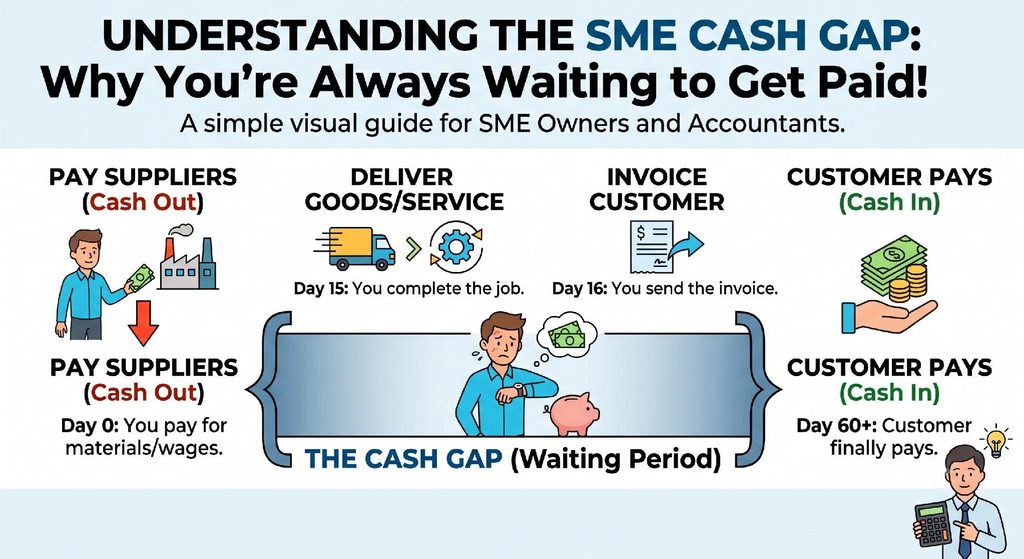
In the world of business, you have to pay your suppliers and your staff and your compliance obligations well before (eventually) you get your cash when the client pays.
The period in the middle is the Cash Gap, and this is where most small businesses have their cash flow issues. This gap is the problem that most businesses face, and that’s what I spend most of my time dealing with (and solving).
Discipline doesn’t fix the Cash Gap
All the business discipline and invoice-chasing in the world can’t solve a structural cash gap – particularly in a cost-of-operating crisis where customer payments are slowing down even more.
There are ways of overcoming this Cash Gap – tools and strategies that have become increasingly affordable and automated and practical. Many of them are available thanks to FinTech disruptors. Many of them use AI to help them supply you with powerful tools to manage your cash flow and grow your business despite today’s business cashflow challenges.
Some 21st century tools to help you escape the Cash Gap
There is a wide a range of smart FinTech tools using AI and big data to deliver solutions. I’m going to cover just three of them in this article as illustrations – but be aware that there are a wide range of lenders with specific offerings and risk appetites. These are just examples – your business may have different needs and drivers.
One is a debtor finance tool, one’s an unsecured overdraft, and the third is a purchasing finance tool that is particularly useful in retail.
I’ll explain what those three products are – so you get an understanding of what’s possible. However, keep in mind that what’s REALLY important is the strategy that’s used to choose and combine individual tools to meet your business needs.
Finanzor Invoice Finance
Finanzor is a FinTech who uses AI exclusively in order to make a lending decision. They plug into your accounting system, be it MYOB, Xero, or whatever. They also take a bank feed, and they look at the cash flow in your business. Overall, they generally have credit criteria that is close to the banks, BUT they provide an overdraft or a credit line or credit based on the receivables in your accounting system NOT personal assets like your home.
To use a “nice round number” example of Invoice Finance, consider a business of around a $10 million turnover, where they have $1 million dollars tied up in their balance sheet and receivables. A provider like this can go in, look at what’s in there, and see the business has $1 million dollars worth of receivables. In this example, they could well offer an $800,000 credit line and at roughly bank rates.
This is a very flexible product, with the advantage that it gives you some diversity in finance suppliers. This is pretty important – because many SMEs are tied up in what I call the single supplier trap with their bank – where EVERYTHING goes through their bank. So if their bank decides it doesn’t like them (the same bank that holds their home mortgage) then they’re in some serious trouble.
(I strongly recommend that you diversify where you borrow – so you have a spread of debt, just like you would have a spread of investments. Having a single finance supplier is a BIG risk.)
It’s a very important thing to understand what you need to adequately fund your business as it grows – because if you have $1 million dollar turnover, you need to have maybe $200,000 in working capital available to operate. (Not what your accounting system thinks is “profit” – actual available cash.)
That’s why tools like debtor finance are important – they give you access to working capital that you have already earned – but which is still sitting in your customers Payables.
Working capital isn’t a fixed amount you need – the more your business grows, the more working capital you need. If you grow your business to $2 million turnover, you ALSO need $400,000 worth of available capital to operate it.
Regardless of what profit your books show at tax time, this time-based need for working capital can’t be filled by your earnings if your customers are paying on 30/60/90 day terms. You’re not going to make sufficient profit to fill that working capital hole, so that’s where tools like Invoice Finance are particularly useful.
Funding your business using money you’ve already earned – using the right, carefully selected invoice financing tool – is a low-risk, high-return growth strategy. Learn to look past the interest rates to understand the underlying costs and risks.
Shift Business Overdrafts
Unsecured Overdrafts are another very easy, flexible financing tool which offers some extremely powerful solutions (“unsecured” means not secured by assets). While this class of tools is more expensive to use than bank finance – say 3 times the mortgage rate – they’re not very expensive to establish.
A product that works for many of my customers is Shift’s Business Overdraft – which is based on data feeds.This tool is an overdraft – so you pay only the annual holding fee – until such time as you access funds. It’s more expensive to use – because it’s unsecured (by physical assets). What it’s secured by is your business balance sheet – so you’re protecting your personal assets.
What an Unsecured Overdraft gives you is flexibility and striking power. It gives you the ability to pivot. As an example (at current rates) – for a holding fee of $500 a year, you get immediate access to up to $100,000 available as a quasi cash reserve.
This means that – for example – when a competitor goes broke across the road, you can walk in and buy all their stock at fire sale values IMMEDIATELY. So you get a lot of flexibility – because you have access to a liquidity pool you can draw on at very short notice.
I have a couple of clients that have these overdrafts in place, and have not (yet) drawn down on them. The $500 per year it costs them to have this access will give them the confidence and the flexibility to strike fast.
Luca Plus Purchasing Finance
A third class of AI-assisted finance tools on the purchasing side of the ledger. One is Trade Finance tool – and another that’s great for smaller businesses is Luca Plus. \
Many people still think that trade finance is basically something used to buy products overseas. That’s changed. Today, there are a range of FinTech domestic trade finance facilities where the supplier pay your bills for you to give you extra breathing space. Trade Finance is useful in industries from construction to retail.
For example, I’ve got a couple of clients in commercial building using Trade Finance. Let’s say one of my builders buys half a million dollars worth of concrete and reinforcement. He has to pay for that in 30 days. That leaves him a massive cash gap to deal with – because he may have to wait 90 days for the developer to pay him.
With Trade Finance, his FinTech lender pays at the 30 day point, and then he has to repay the lender at 90 days. That solves the cash gap from the other direction – and gives him a way of managing liquidity there.
There’s also a really useful tool called Luca Plus. It is a smaller, more available purchasing finance product that’s great for many SMEs. It’s very good in any retail-type space, where you don’t have any debtors to use.
What it does – once again – is hook into your accounting system plus take a bank feed – so it understands what you do and the value of your business. You can use to solve a range of SME cash gaps – in retail and smaller businesses – when you need to prepare for that rush for Easter; or access extra funds to cover the Christmas season when no one pays you
How does it work? Let’s say you’re a retailer – and it’s coming up to Christmas. You want to buy $40,000 worth of stock BUT you don’t have $40,000 worth of liquidity.
Luca Plus will give you the $40,000 up front, and you pay it back at $10,000 a month over the next four months. Currently, the charge is around 1.5% per month, which is really cheap – particularly if you can get a good return on your stock.
The starting point for financial flexibility (and major stress relief) is a strategy, not a tool
When it comes to using any or all of these smart, flexible Working Capital finance tools (and there’s a myriad of them out there) – what you really need first is a well-informed strategy.
That’s the real value I offer to my clients. Not just a “product” – but an ongoing strategy built on a solid understanding of their business.
Together we create and implement a strategy that works for their business. A strategy that adapts and changes as their business grows and changes – because we regularly review, implement, and monitor it.
As your business grows and the world changes, your funding needs will (and should) change. Eventually – when you have enough retained profits – you may not need Debtor Finance or Trade Finance.
However, it takes time to accumulate enough Working Capital within your business to manage your cash gap. In the meantime, you can either leverage today’s smart, tech-enabled Financing Tools OR live in a constant world of cash flow stress, sadly watching opportunities pass you by because you don’t have the Working Capital to fund them.
If you’re tired of endless bill-juggling and missed opportunities, then get in touch for a Virtual Coffee and Conversation.