
The best business finance deal you’ve never heard of
IN SHORT…
During a recent housing industry webinar I sat in on, one of the “expert presenters” finished their piece about the challenges faced in construction with this comment:
“It’s lucky we’re a resilient industry”
It really didn’t sit well with me – because it totally glossed over the clear and present danger facing a lot of businesses in the construction industry today – the growing risk of having your business go under through no fault of your own because one of your big customers stopped paying their bills.
It went down about as well as a central banker saying “the pain of ongoing interest rate rises is necessary” – implying that individuals have to suffer and lose their homes and fall into poverty because inflation is “too high” and has to come down “for the good of society as a whole”.
It totally ignores the massively painful and harmful impacts of a SME failure on the business owner, their family, their employees and their subcontractors.
The housing industry as a whole WILL probably keep going – because Australia has a massive housing shortage.
Big picture generalisations hide waves of individual tragedy
While “the industry” may continue, there are a LOT of small businesses in the construction industry at risk of going to the wall – through no fault of their own.
They’re small businesses whose only “mistake” has been to accept the 30/45/60 day credit terms forced on them by big customers – without developing an effective strategy to compensate for the cash gaps that are forced on them by these interest free loans.
Those small businesses are increasingly faced with growing levels of stressful cash flow shortages created by increasing credit terms.
They are also facing an additional and growing risk – as costs and disruptions increase and increase and increase – that a single larger customer will go under and take them down too.
30 days is becoming 45, 45 days is becoming 60
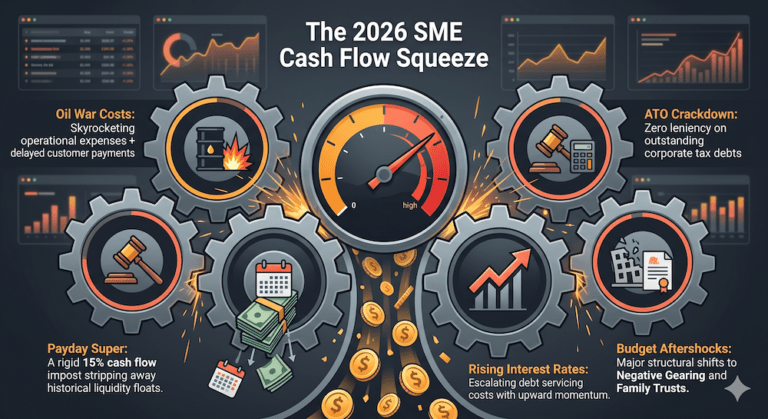
Fuel costs, interest rates, payday super, compliance costs – cash flows across Australian industry are under growing assault from local and international sources.
Everybody’s paying a fair bit slower than they used to – and that has massive flow-on consequences down every supply chain. Particularly for SMEs at the bottom of the cash flow food chain – at least for those without a practical, affordable cash flow strategy.
You can’t solve 21st century cash flow problems with 20th century approaches
There are practical and affordable solutions that small and medium sized Australian construction companies can implement IF they are prepared to go beyond what “everybody knows about business financing” that’s just no longer so.
One useful, affordable strategy is actually a “twofer” (two-for-one)
Instead of traditional fixed term business loans, small, smart Australian businesses are covering their cash gaps with Debtor Finance (also called Invoice Finance).
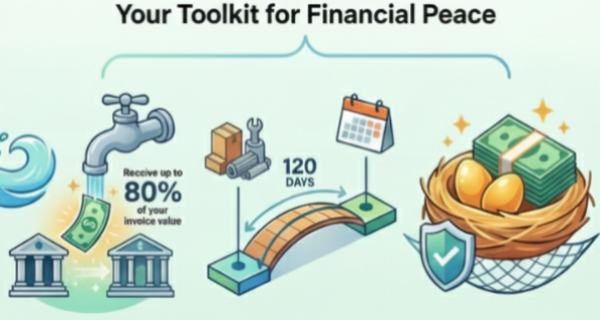
Not only does Debtor Finance give them affordable access to around 80% of their customers’ invoice value when they invoice – it ALSO gives them wholesale access to Debtor Insurance. That’s a very good deal in troubled times.
“And there’s more” – the application process includes independent credit checks on the customers you choose to cover. This means you get a free check on who you’re lending your money too – and a LOT of peace of mind.
Debtor Insurance has been in the retail market for decades – but it’s been financially out of reach for most SME businesses. Many SMEs have just assumed that Debtor Insurance must always be super-expensive – and probably won’t cover much anyway.
What does Debtor Insurance cover?
Essentially, with Debtor Insurance you’re buying an insurance policy to cover the risk that the customers you have already invoiced will default on paying you.
This means that if you have Debtor Insurance and a significant customer goes bust, then you will get 80% of what you’re owed – fast.
What does this mean? If a customer with $50,000 in unpaid bills suddenly goes to the wall then you get $40,000 of what you’re owed immediately. You won’t be waiting and hoping for payment for months – while lawyers, administrators and auditors take their cut.
What does Debtor Insurance cost?
Stand-alone Debtor Insurance can be expensive. However, Debtor Insurance as an add-on to Debtor Finance is a whole other ball game – because the policy is actually “bought” by the finance provider – and THEY get it at super-bulk-wholesale rates.
Debtor Insurance can also be configured to cover just your more risky clients, which further minimises fees.
What sort of rates?
At time of writing (October 2026) I’m seeing rates at around 0.3% to 04% of the amount of debtor invoices insured WITH DEBTOR FINANCE. Compare that to the 2% to 3% of a stand-alone Debtor Insurance policy.It’s a tiny amount in the scheme of things.
That’s a pretty good safety belt at this point in time – particularly as the Christmas black hole looms.
Should you consider Debtor Finance and Debtor Insurance?
We’re quietly sneaking up on Christmas – which leads into the annual January “payment black hole” – the month (or more) when Christmas spending and sales have finished, and everyone takes a break (including your customers’ accounts departments).
This is when some of those SMEs who have been hanging on by their fingernails through rising prices and interest rates – waiting and hoping that “things are going to get better” – will hit a wall they can’t get over.
In this environment, a Debtor Insurance “life jacket” at 0.3% to 0.4% is pretty much a no-brainer. It’s a super small price to pay to protect your business and your livelihood.
Where there’s a business problem, entrepreneurs build business solutions
Fintech entrepreneurs have been leveraging the real time, cloud-based functionality of today’s accounting tools to build smarter, more flexible SME finance tools for more than a decade.
Debtor Finance is a particularly powerful and useful business solution for SMEs in today’s B2B market – a place where big customers impose long credit terms.
Today, you can not only upload your expense receipts directly to your accounting system from your smartphone, you can ALSO get affordable access to the bulk of the cash you’ve earned as soon as you invoice (if you need it).
Likewise, you can potentially also affordably insure against the failure of key customers.
Does your 20th century financing strategy need an upgrade?
Here’s a quick checklist:
- Do you spend hours per pay cycle scraping together the cash to make payroll?
- Do you regularly have sleepless nights waiting for a big customer who’s paying a few days later each month?
- Do you look at just how much of your home’s value is in your bank’s hands – and worry whether a downturn in house prices could have your bank review what they’re prepared to lend you?
If this is you – and you are getting seriously concerned about what the festive season close down could do to your business – then you might want to explore my SME Operator’s Guide to Debtor (Invoice) Finance – and then book a free Working Capital Strategy Review.